.png)
Object Record
Images
Metadata
Object name |
Sword, Presentation |
Date |
1740 |
Place of origin |
U.S. |
Physical description |
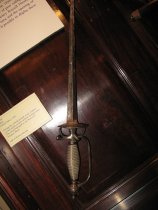
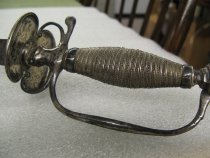
Presentation sword belonging to the Revolutionary Solomon Mead, 4th great-grandfather of Mr. Robert Brooke (1725- 1812); silver hilted sword with original belt and seatbard The sword is most likely an America small sword. These types were the popular civilian pattern at the time of the American Revoultion. They feature a narrow, straight blade that was used for thrusting and a light hilt. The hilt consists of a simple knuckle bow, pas-d'ane, modified urn pommel & a bilobate counter-guard. It was the most common sword type used by the American officers during the war. Underside of coutergaurd hand carved with the letters "AM" on one side, and "SH" on the other. |
Current exhibit |
Path to Liberty: The Emergence of a Nation |
Gallery label |
Path to Liberty (2025): Continental soldiers carried most of their own supplies from battlefield to battlefield. This included weapons, musket balls and powder horns, and extra clothing. One soldier might carry over 45 pounds of gear, with his musket alone weighing 10 to 15 pounds. At the start of the war in spring 1775, militia men brought their personal weapons, including muskets and swords. By November that year, the Continental Congress sought to standardize weapons across the Army, and began issuing them directly to soldiers. These standards included use of .75 caliber muskets with barrels measuring three feet and eight inches long, and steel ramrods. The musket on display bears the symbol of the British East India Company and the initials "TOW" for "Tower of London" on its lock plate. While some soldiers owned guns before the war, some muskets used by Patriots were captured from British arsenals. Soldiers also collected and reused enemy musket balls found on the battlefield. Officers carried polearms, like the halberd and sword shown here. General Washington favored officers carrying polearms, recognising that their attention was needed for troops under their command, and muskets would divert that attention. However, this made officers vulnerable to attack, so they often carried pistols for protection. Pistols, then, became both a necessary defense and a status symbol within the Army. |
Catalogue number |
1954.01.001A-C |
Collection name |
Tools and Equipment |
Credit line |
Gift of Mr. Robert Brooke, 1954 |