.png)
Object Record
Images
Metadata
Object name |
Engraving |
Title |
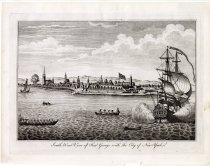
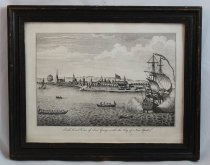
South West View of Fort George with the City of New York |
Artist or maker |
unknown |
Date |
unknown |
Place of origin |
England (?) |
Materials and techniques |
ink on paper |
Physical description |
Southwestern view of Fort George in the background with a large frigate, three small rowboats, and one sailboat in the harbor in the foreground. |
Past exhibit |
Fear and Force: New York City's Sons of Liberty |
Gallery label |
Throughout the thirteen colonies, the Sons of Liberty, whose organization was linked from town to town, were known to physically harm Loyalists as a way to demonstrate their dissatisfaction with Parliament. This type of resistance took several different forms, one of which had been an aggressive scare tactic practiced in medieval times: tar and feathering. The colonists' adaptation included applying hot or cold pine tar to the skin or clothing of a person with a brush, then covering them in feathers from pillows and cushions. Once fully tarred and feathered the victim would be paraded around the town' s major streets while onlookers jeered and shouted. This public shaming was effective in deterring others from repeating the same transgression. The Sons of Liberty were known to have been the leaders of this castigating resistance method. There are four known instances of tar and feathering in New York City between September of 1769 and August of 1775. In one instance, a shoemaker, Tweedy by name, was tarred and feathered on August 22 , 1775, because he had spoken out against Congress. Tar and feathering had its most prolific years between 1768-1770. This engraving depicts two Boston Patriots forcing a tarred-and-feathered customs officer to drink tea under the gallows. The rosette, or bow, in the hat of the Patriot on the right signifies that he is a Son of Liberty. The "45" on the hat of the other Patriot is a reference to the famous 1763 case of John Wilkes, a political agitator, member of Parliament, and idol of the resistance movement in the American colonies. On April 23, 1763, Wilkes published a highly antimonarchical article titled "No. 45" in the newspaper The North Briton. King George III was furious and ordered Wilkes arrested but, as a member of the House of Commons, the radical author was exempt from prosecution. |
Catalogue number |
1986.08.006 |
Collection name |
Drawings and Prints |
Credit line |
Gift of Stanley D. Scott, 1986 |
Subjects and places |
New York New York City Fort George |