.png)
Object Record
Images
Metadata
Object name |
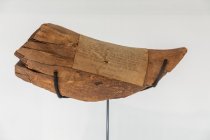
Tree Fragment |
Date |
about 1719 |
Place of origin |
New York City, NY, USA |
Materials and techniques |
wood |
Physical description |
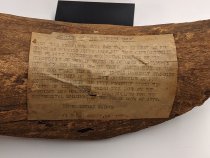
Portion of the Liberty Tree that was located in Bowling Green Park. Inscription reads: "Portion of 'The Liberty Tree' This tree stood for over 240 years in what is now known as Bowling Green Park, New York City (opposite the present Customs House) being removed by the Department of Public Parks on Oct. 21, 1919. When cut down, the rings on the trunk showed that it was over 200 years old so that it was probably standing during the days of the Dutch occupancy of New Amsterdam. Within 200 feet stood the statue of King George Third torn down by the populace and molded into lead bullets for the Continental soldiers in the early days of 1776. --Edwin Irvine Haines 41 Broad Street, New York." |
Past exhibit |
Fear and Force: New York City's Sons of Liberty |
Current exhibit |
Path to Liberty: The Emergence of a Nation |
Gallery label |
This wooden fragment is part of a tree removed by the Department of Public Parks on October 21, 1919, from Bowling Green Park. The tree's trunk rings showed over 200 years of growth revealing its place in the park since the early 1700s. This tree was a witness to many protests by the Sons of Liberty. Path to Liberty: The Emergence of a Nation (2025): In 1770, New York officials erected a statue of King George III to celebrate the King’s repeal of the Stamp Act. The gilded lead equestrian figure stood atop a fifteen-foot-high marble pedestal, the largest sculpture in the colonies. A year later, when relations between King George III and his American subjects deteriorated, the city built a protective wrought iron fence around the monument. This piece of the fence was collected during the 1938 renovations of Bowling Green prior to the World’s Fair the following year. After the Declaration of Independence was read at the Commons (the site of City Hall today) on July 9th, 1776, the Sons of Liberty, led by Isaac Sears, and a crowd of Patriots rampaged through the city’s streets. They traveled down Broadway, breaking windows in the homes of known Loyalists, before arriving face to face with the statue at Bowling Green. They broke through the fence and pulled the statue off its pedestal, mangling the horse and its disgraced rider. Nearly all 4,000 pounds of lead were melted into musket balls and used to fight the British Army. |
Catalogue number |
X25 |
Collection name |
Historical Artifacts |
Credit line |
Collection of Fraunces Tavern Museum |
Subjects and places |
New York |