.png)
Object Record
Images
Metadata
Object name |
Currency |
Artist or maker |
printed by Samuel London |
Date |
1776 |
Place of origin |
New York |
Materials and techniques |
paper and ink |
Physical description |
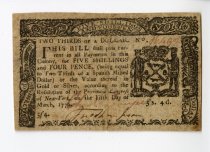
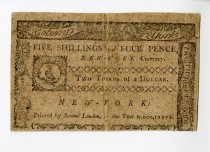
Five shillings and four pence New York currency note. Frame labelled "currency of the 13 original colonies." The front has a seal with two standing figures and a crown in the middle between them. The crown is above an "x" shaped symbol and four small, indestinguishable symbols, possibly animals? Dated the "fifth day of March, 1776." There is an illegible signature handwritten at the bottom. The back reads "FIVE SHILLINGS AND FOUR PENCE" and "NEW YORK:" above the words "printed by Samuel London in the year M, DCC, LXXV1." There is a symbol of a bird surrounded by the words "FORTIS.A.FORTE." |
Current exhibit |
Path to Liberty: The Emergence of a Nation |
Gallery label |
Path to Liberty: The Emergence of a Nation (2025): Great Britain often failed to supply its American colonies with enough coinage and prohibited them from creating their own, resulting in frequent money shortages. Trade with the West Indies introduced Spanish and Portuguese coins into the colonies. Colonists cut coins into pieces to make change, which you can see in the quarter cut Spanish Pistareen. When they ran out of metal for their coins, they made paper notes that could later be redeemed for coins. Going back as far as 1690, individual colonies produced their own paper notes as temporary placeholders for a shortage of British currency.13 Shortly after the Revolutionary War began in 1775, the Continental Congress also issued its own paper currency to support rising costs of the war. Colonies and the Congress continued printing money without taxing the surplus out of circulation, which led to high levels of inflation that made both paper notes virtually worthless. At the 1787 Constitutional Convention, delegates voted to prohibit state governments from coining money or issuing currency. Soldiers in the Army filled their pockets with both practical items necessary for survival and materials to pass the time between battles. Some of the things they carried included flint for muskets and campfires, clay pipes, and money. |
Catalogue number |
2019.01.011 |
Collection name |
Manuscripts and Ephemera |
Credit line |
Gift of Kent D. and Tina K. Worley, 2019 |
Subjects and places |
New York Colonial America |