.png)
Object Record
Images
Additional Images [1]
Metadata
Object name |
Mural |
Title |
The South Prospect of the City of New York in America |
Artist or maker |
unknown |
Artist or maker |
after William Burgis (British, active America 1716–1731) |
Date |
early 20th century? |
Place of origin |
New York City, New York |
Physical description |
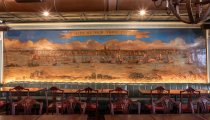
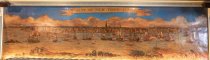
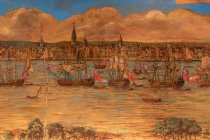
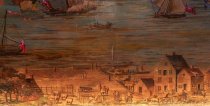
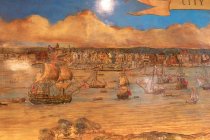
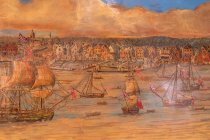
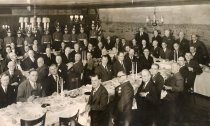
Wall mural painted in Bissell Room on the first floor of 101 Broad St. The mural depicts the south side of New York City along the water, with ships and boats in the foreground. Image after William Burgis's 1717 engraving titled "The South Prospect of the City of New York in America," which is credited as the earliest panoramic view of New York City and the East River. In the front table: Shelby Davis, president of the SRYN from 1951-1953. |
Historical context |
This mural is based on the Burgis View of New York City first sketched by William Burgis in 1717. Burgis's drawing was originally produced in large format, printed over six feet long. According to advertisements from the time and other contemporary sources, large maps and "prospects" like this one were common furnishings in seventeenth- and eighteenth-century houses. Printers later reproduced smaller versions in broadsides and other publications throughout England and America. In 1739, artist Thomas Bakewell purchased the original plates from John Harris, who first engraved Burgis's drawing in England, and republished it in his own name in 1746. Bakewell made several changes, including adding/redesigning multiple buildings in the city skyline, adding more ships, and adding a layer in the foreground. The layer in the foreground also has people, trees, and seated figures holding coats of arms, as well as a dedication that describes what is happening in the image. Later in 1761, an unknown artists reproduced the Burgis View without Bakewell's modifications and published them in the London Magazine. Our version contains an inscription at the top of the engraving that reads: "Engrav'd For the London Magazine 1761." This engraving is also related to the mural 2025.01.001 in the museum's collection. In the early- to mid-twentieth century, an unknown artist painted a version of the Burgis View in the Bissell Room of Fraunces Tavern. The mural may have been informed by both Burgis's original 1717 engraving and copies of it, such as this 1761 version, because it lacks Bakewell's revisions. It is unknown whether the SRNY commissioned the mural. The museum accessioned the mural in January, 2025 and hired an art conservator to treat it. - M. Valenzuela, Curatorial Associate, 7/16/2025. Sources: 1. Stokes, L.N. Phelps and Daniel C. Haskell, "American Historical Prints Early Views of American Cities,etc." pp. 11; (see also figures B-48 and 55 from this book), The New York Public Library, 1933; 2. Library of Congress, "The south prospect of the city of New York in America," digital ID: pga 08892 //hdl.loc.gov/loc.pnp/pga.08892 and cph 3b16927 //hdl.loc.gov/loc.pnp/cph.3b16927 , Library of Congress control number: 2004672441; 3. Mellby, Julie L., Princeton University Library Graphic Arts Collection, "New York City 1716," July 13, 2013, https://www.princeton.edu/~graphicarts/2013/07/post_90.html (printed version of this blog post also available in the hard copy file for this record). 4. "Advertisements," The New-England Courant (Boston, MA), Aug. 20, 1722. (printed copy available in the hard copy file for this record) On January 24, 1975, a group of Puerto Rican nationalists, the Fuerzas Armadas de Liberacion Nacional Puertoriquena (F.A.L.N) set off an explosive in the Bissell Room where this wall mural is painted. Four men were killed and several more were injured in the explosion that severely damaged the lower level of the building and the adjoining Angler Club. Additionally, the force of the explosion created a large crack in the wall where this mural is painted, which has remained since the event in 1975. In January 2025, the wall mural was accessioned into the Fraunces Tavern Museum's collection in the hopes of conserving the crack in the wall, which the museum's board believes may pose a threat to the structural integrity of the building. (Source: "4 Killed, 44 Injured in Fraunces Tavern Blast" by Robert D. McFadden for the New York Times, January 25, 1975). - M. Valenzuela 1/24/2025 |
Gallery label |
On display in the Bissell Room of Fraunces Tavern, 2025: This mural shows one of the earliest depictions of New York City. William Burgis (active 1716-1731) first sketched this image of Manhattan Island from the perspective of Brooklyn Heights in 1717. His "Burgis View" was over six feet long and captured multiple recognizable locations along the waterfront of Lower Manhattan, including City Hall, the Dutch Church, and parts of Nutten Island, now Governor’s Island. Burgis later published his engraving in England between 1718 and 1719. Large maps and "prospects" like this one were common furnishings of seventeenth- and eighteenth-century houses. Artists have reproduced versions of the Burgis View for over two hundred years. In 1739, Thomas Bakewell reproduced the engraving and added more buildings, ships, and a layer in the foreground with people, trees, and coats of arms. An anonymous artist re-published a version of the Burgis View without Bakewell’s revisions in a 1761 edition of the London Magazine. This mural combines elements from all three, including Burgis’s original perspective, Bakewell’s ships and civilians, and billowing clouds from the 1761 version. The banner at the top of this mural reads: "City of New York 1717." The artist who painted this mural may have added this in reference to the date of Burgis’s original engraving. Head upstairs to the Long Room in Fraunces Tavern Museum and to see the Burgis View that would have been featured in broadsides and other publications around 1761. |
Catalogue number |
2025.01.001 |
Collection name |
Paintings and Sculpture |
Subjects and places |
New York City New York USA |