.png)
Object Record
Images
Metadata
Object name |
Set, Flatware |
Date |
18th century |
Place of origin |
United States |
Materials and techniques |
horn, metal |
Physical description |
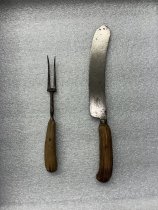
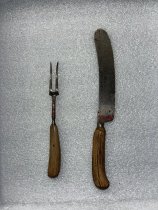
Flatware set of two pieces: a horn handled knife and a two pronged fork. |
Historical context |
Carried by Revolutionary War soldier Job Wilcox of Exeter, R.I.. He was a private in Captain Herrington's Company of militia, and in Colonel Dyers regiment from Nov. 8, 1777 to Dec. 8, 1777. Wilcox later served as a Coporal from Dec. 25,1777 to Jan. 17, 1778. Source: Colonel and Mrs. George Francis Terry |
Past exhibit |
Sons of the Revolution in the State of New York History |
Current exhibit |
Path to Liberty: Orders, Discipline and Daily Life |
Gallery label |
Obedience and discipline were essential for the survival of the Continental Army. This orderly book, kept by Captain Benjamin Tallmadge, documents daily orders and reflections from the early days of the War, when his regiment was stationed in New York. On July 26, 1776, Tallmadge expresses concern over soldiers mistreating local townspeople near the market that supplied their camp. He warns that undermining civilian cooperation might jeopardize the Army’s health: "Health of the soldiers much depends on the Supplies of Vegetables – Those who have been guilty of such practices will do well to consider what will be our situation if we drive off the Country people & break up the Market. The healthy will soon be sick & the sick will perish for want of necessaries." In an entry from August 9, 1776, Tallmadge records General George Washington urging officers and soldiers to remain vigilant, maintain their arms, and recall the high expectations placed upon them by the cause of independence: "The General exhorts all both officers & soldiers to be prepared for action, & to have their Arms in the best order, & not to wander from their Quarters or Encampment; to remember what their Country expects from them, What a few and brave men have lately done in South Carolina Against a powerful fleet & Army; to acquit themselves like men, & with the blessings of Heaven on so just a cause we cannot doubt of Success." At that time, Tallmadge was commanding a company in the Second Continental Light Dragoons, a cavalry regiment tasked with reconnaissance, rapid movement, and communication across the Army. His men and unit played a supporting role in the defense of New York. Benjamin Tallmadge (1754–1835) later became George Washington’s chief intelligence officer and founded the Culper Spy Ring, a network that operated in and around British-occupied New York City to relay strategic information to the Patriot command. |
Catalogue number |
1968.02.001ab |
Collection name |
Tools and Equipment |
People |
Wilcox, Job |
Subjects and places |
United States |